What to Practice in a Canoe Before You Leave the Shore
I’ll help you build a short, sensible practice routine for balance, stopping, turning, and communication before a canoe trip. The goal is to catch awkward habits on shore or in shallow water, where fixing them is easier on you and your boat.
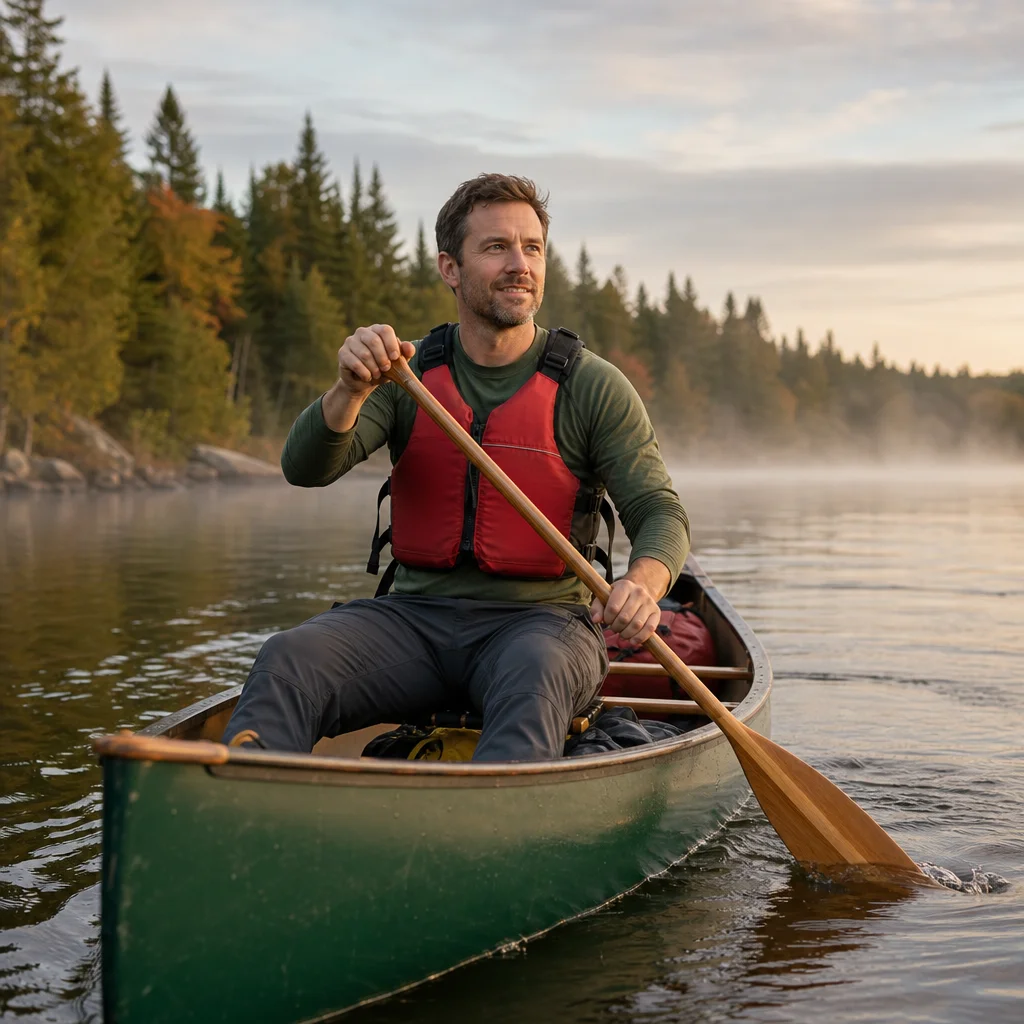
The first few minutes in a canoe can reveal problems that are much harder to solve once you’re away from shore. A paddle may feel unfamiliar, your partner may not understand your commands, and a simple turn can send the boat farther off course than expected.
I recommend practicing a small set of skills before committing to open water. You don’t need a full lesson or an elaborate obstacle course. You need enough room to learn how the canoe responds, confirm that both paddlers can communicate, and identify anything that needs adjusting while help is close by.
Set Up a Useful Practice Area
Choose a calm, protected spot with an easy exit. A gently sloping shoreline, quiet cove, or shallow area free of rocks and submerged branches works well. The water should be shallow enough that a paddler can stand if necessary, but not so shallow that the paddle or hull repeatedly strikes the bottom.
Wear your properly fitted personal flotation device before entering the canoe. Keep the boat lightly loaded for practice, with gear secured so it can’t shift under your feet. If you’re paddling with someone else, agree that either person can call a stop at any time.
A short dry-land check is worthwhile:
- Confirm that seats, thwarts, and foot braces are secure.
- Place heavier gear low and near the center of the canoe.
- Keep loose items from becoming foot obstacles.
- Check that each paddle is the right length and free of cracks.
- Decide who will sit in the bow and who will sit in the stern.
- Establish simple commands before launching.
The last point matters more than it sounds. Confused instructions often lead to rushed strokes, leaning, and avoidable bumps. Clear communication is a form of boat maintenance: it reduces the hard contacts that can damage a hull, paddle, or person.
Check the launch conditions: Before practicing, confirm current local access rules, water conditions, weather, and any required safety equipment. These details vary by location and can change, especially on moving water or at managed parks.
Begin With Balance and Sitting Position
Start with the canoe parallel to shore if possible. One person should steady the boat while the other steps into the center of the canoe, keeping weight low and using the gunwales only for balance. Avoid grabbing a single side and pulling hard; that can tip the boat toward you.
Once seated, take a moment to notice the canoe’s movement. Make small, deliberate shifts:
- Move your shoulders slightly forward and back.
- Shift your weight a little from one hip to the other.
- Rotate your torso without leaning the boat.
- Return to a centered, relaxed position after each movement.
The aim isn’t to make the canoe rock dramatically. It’s to learn how little movement is needed to influence the hull. Keep your upper body relaxed and let your hips respond to the boat. Stiffening your arms or clenching the gunwales can make every small wave feel larger.
For a tandem canoe, have the bow paddler sit or kneel in a stable position, then let the stern paddler enter. If either person needs to change position, communicate first and move one at a time. Practice shifting a few inches rather than making a sudden, full-body adjustment.
If the canoe feels unstable while empty or lightly loaded, stop and investigate. A loose seat, incorrect seating position, uneven gear, or a hull that is taking on water can all affect handling. Don’t treat persistent instability as a skill problem that you simply need to tolerate.
Practice Starting and Stopping
Before working on turns, learn to control speed. From a stable position, take a few easy forward strokes. Keep the strokes smooth and close to the canoe rather than reaching far out and pulling aggressively.
After two or three strokes, stop paddling and observe how the canoe glides. Then practice stopping with a reverse stroke. Place the blade near your hip, push water toward the bow, and recover without twisting excessively. You don’t need a forceful stroke; you need a predictable one.
Practice this sequence several times:
- Paddle forward slowly.
- Call “stop” clearly.
- Both paddlers stop their forward strokes.
- The stern paddler uses a gentle reverse stroke if more braking is needed.
- Wait until the canoe settles before starting again.
A tandem crew should also practice stopping when only one paddler acts. On some trips, one person may need to avoid an obstacle, manage a line, or respond to a problem while the other controls the canoe. Agree on whether “stop” means “stop paddling” or “actively brake,” and use different words if you need both commands.
The objective is controlled deceleration, not an abrupt halt. Hard, hurried reverse strokes can unsettle the canoe and strain shoulders. Smooth control is kinder to the paddlers and to the equipment.
Practice Straight-Line Paddling
A canoe rarely travels perfectly straight without correction. That doesn’t mean the paddler is doing something wrong. Paddle shape, wind, current, seating position, and the canoe’s design all influence its path.
On calm, shallow water, paddle toward a visible point such as a buoy, shoreline feature, or tree. Use relaxed forward strokes and notice how many strokes you can take before correcting course. Keep corrections small. A wide, sweeping correction may turn the canoe more than you intended and force another correction in the opposite direction.
In a tandem canoe, the stern paddler usually has more influence over the canoe’s direction, while the bow paddler helps provide power and can point out hazards. Both paddlers should understand that this is a working arrangement, not a strict rule. Practice changing speed and rhythm without blaming the other person when the canoe wanders.
Practice Gentle Turns in Both Directions
Begin with wide turns. A forward stroke on one side naturally encourages the canoe to turn away from that side, while a sweep stroke makes the turning effect more pronounced. Use gradual movements and allow the canoe time to respond.
Try this simple routine:
- Paddle forward for several strokes.
- Make a wide turn to the left.
- Stop and regain a neutral position.
- Paddle forward again.
- Make the same kind of turn to the right.
- Repeat with smaller and then slightly tighter turns.
Tandem paddlers should practice who does what. One person can provide forward power while the other makes a steering correction. Later, try coordinated strokes: one paddler uses a forward stroke while the other uses a reverse stroke to rotate the canoe more quickly.
Keep the canoe reasonably level during turns. Leaning far over the side can make a turn feel dramatic, but it also reduces your margin for error. For beginners, a level hull, slow speed, and measured strokes are usually the more reliable combination.
Avoid practicing tight turns near rocks, docks, swimmers, or other boats. A skill that feels manageable in open space may become awkward when there’s pressure to avoid something.
Practice Communication Without Guessing
Use short commands that everyone understands. A useful set might include:
- “Forward” — begin or continue forward strokes.
- “Stop” — stop paddling and let the canoe settle.
- “Back” — use reverse strokes to slow or move backward.
- “Left” or “right” — identify the intended direction of travel.
- “Hold” — maintain the current position or stroke while the other paddler makes a correction.
- “Emergency” — pause the routine and focus on an immediate hazard.
You can use different words, but define them before launching. Practice calling a command from the bow and responding from the stern, then switch roles. Make sure the person giving instructions says what they need before the canoe reaches an obstacle.
Communication should remain calm and specific. “Watch out” doesn’t tell the other paddler whether to stop, turn, or move forward. A clear “stop, branch ahead” gives the crew something useful to do.
Finish With a Short Recovery Drill
You don’t need to deliberately capsize a canoe to prepare for trouble. For beginners, practice the decisions that come first:
- Stop paddling.
- Keep your body low and centered.
- Hold the canoe or paddle only if doing so doesn’t pull you under or away from the boat.
- Call for help clearly.
- Follow the local and course-specific rescue guidance you’ve been given.
If you’re taking formal instruction, an instructor can demonstrate capsize recovery in a controlled setting. Don’t improvise a swim test in cold, deep, moving, or isolated water. Water temperature, distance from shore, wind, current, and local rescue options all change the risk.
A Ten-Minute Pre-Launch Routine
When time is limited, use this order:
- Check the canoe, paddles, flotation devices, and load.
- Review commands and agree who will steer.
- Enter and practice small weight shifts.
- Paddle forward and stop several times.
- Make a wide turn in each direction.
- Practice one coordinated correction with your partner.
- Review what you’ll do if someone falls out or the canoe drifts away.
If a skill feels uncertain, repeat it rather than moving immediately to a harder version. The point of shore-side practice isn’t to prove that you’re ready for every condition. It’s to find the weak spots while correction is simple.
Before leaving the launch, make one practical decision: are the current conditions appropriate for the skills you’ve just practiced? If the answer is no, choose a more protected route, postpone the trip, or get additional instruction. A few minutes of preparation can save a long, uncomfortable paddle back—and help keep small handling mistakes from becoming expensive damage.