The Forward Stroke: Making a Canoe Move Straighter With Less Effort
I’ll explain how posture, paddle placement, a quiet recovery, and small steering corrections work together to keep a canoe moving straighter. You’ll also learn which common habits waste energy and how to practice the forward stroke without zigzagging.
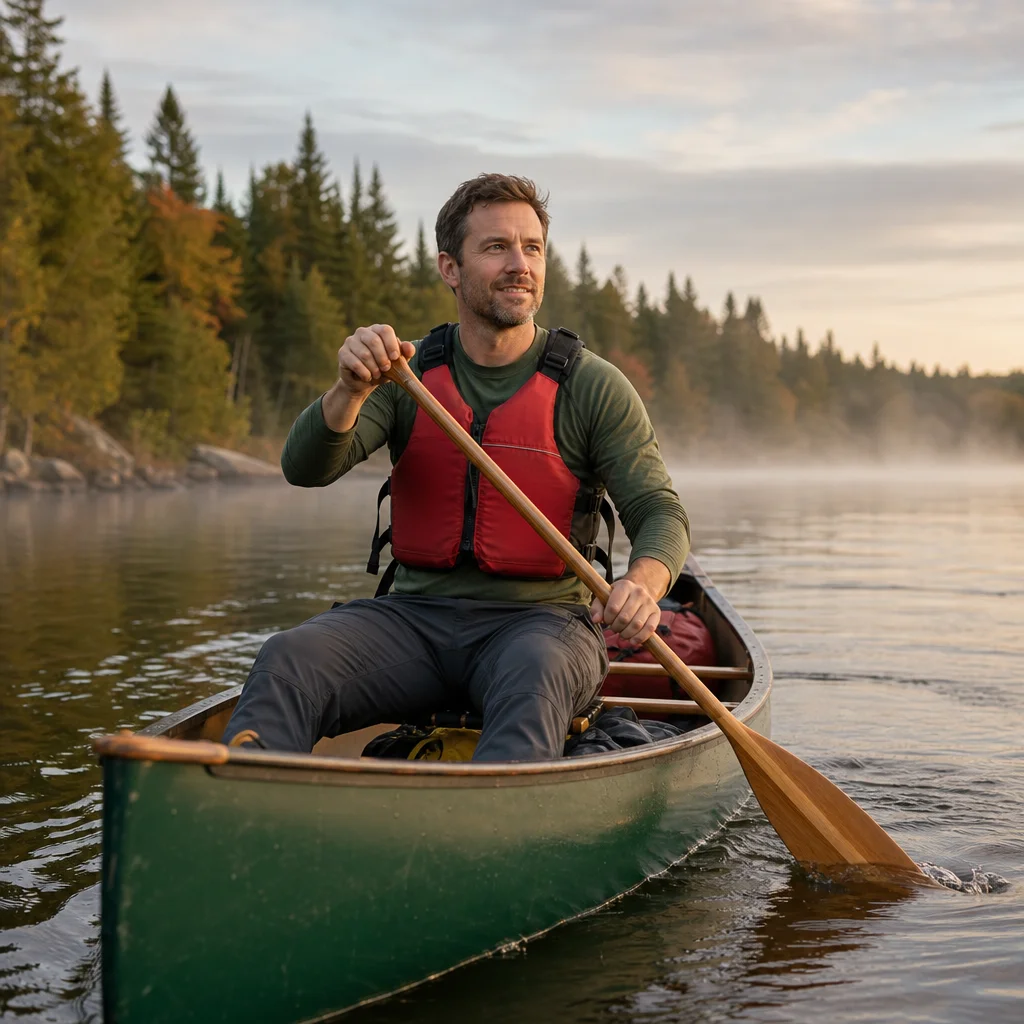
A canoe that wanders from side to side can make an easy outing feel like hard work. Beginners often respond by paddling harder, but extra force usually magnifies the problem: the canoe turns more sharply, the paddler reaches farther, and the next correction becomes larger.
A straighter, more efficient forward stroke comes from controlling where the paddle enters, where it applies power, and when it leaves the water. The goal isn’t to keep the canoe perfectly motionless on its line. Every canoe needs small corrections. The goal is to make those corrections early and gently.
Start with a stable paddling position
Good strokes begin before the paddle touches the water. Sit or kneel in a position that lets your torso rotate without making you feel cramped or unstable.
If you’re sitting, keep your feet supported and your knees relaxed. If you’re kneeling, place a cushion under your knees and keep your weight centered rather than leaning heavily against one side of the canoe. Either position can work; comfort and control matter more than copying someone else’s posture.
Keep your back reasonably upright, with a slight forward inclination at the start of the stroke. Avoid collapsing your shoulders toward the paddle. Your upper hand should stay roughly in front of your chest or shoulder, while your lower hand controls the shaft without squeezing it excessively.
A loose grip helps the paddle move smoothly. Hold it firmly enough to maintain control, but don’t clench your hands throughout the stroke. Tension in your hands and shoulders makes the stroke shorter and less precise.
Use torso rotation instead of arm power
The arms connect you to the paddle, but your torso should provide much of the useful movement. At the beginning of the stroke, rotate your shoulders and upper body slightly toward the paddle side. This places the blade forward without forcing you to reach only with your arms.
As the blade moves through the water, let your torso rotate back toward a neutral position. Your arms can bend and extend naturally, but they shouldn’t do all the work. A stroke driven mostly by the arms tends to be short, tiring, and inconsistent.
Think of the movement as winding and unwinding your upper body. You’re not trying to twist as far as possible. A comfortable rotation is enough, especially while you’re learning to keep the canoe balanced.
Place the blade quietly near the bow
For a forward stroke, the blade should enter the water ahead of your body, usually near your toes or slightly forward of them. The exact position depends on your seat, paddle length, and canoe, but reaching far beyond a comfortable position often causes trouble.
Lower the blade into the water rather than slapping it down. A quiet entry gives you a better connection and avoids pushing the canoe sideways. Fully submerge the blade before applying significant pressure.
The shaft should be fairly close to vertical when viewed from the front. If the shaft angles sharply away from the canoe, the stroke sends more force sideways and encourages the canoe to turn. A vertical shaft also makes it easier to place the blade consistently from one stroke to the next.
You don’t need to jam the blade deep into the water. Submerge the working portion of the blade, keep it covered during the power phase, and avoid burying it so deeply that the canoe slows when you try to pull it back.
Apply power beside the canoe, not behind you
Once the blade is planted, move it backward through the water while keeping it relatively close to the canoe. The power phase should finish around your hip or slightly behind it, depending on your technique and the canoe’s response.
Many beginners pull the blade all the way back to their seat. That feels like a longer stroke, but it often makes the canoe turn. As the paddle travels behind your hip, its leverage can push the stern sideways and pull the bow away from your paddling side.
A shorter stroke with a clean exit is usually more effective than a long stroke that drags behind you. Keep the blade moving smoothly rather than trying to accelerate it with one abrupt tug.
Use your torso and body weight first, then let your arms finish the movement. Your lower hand can guide the shaft while your upper hand helps maintain the blade’s angle. If your shoulders are rising toward your ears, you’re probably using too much tension.
Recover cleanly and reset early
At the end of the power phase, remove the blade near your hip. Don’t keep it in the water just because you still have room to pull. A dragging blade acts like a brake and can steer the canoe away from your intended line.
For the recovery, rotate the shaft forward and return the blade to the starting position. Keep the paddle close to the water so the movement stays relaxed and controlled. There’s no need to swing the blade high in the air between strokes.
The recovery is part of the forward stroke, not dead time. A smooth recovery lets you place the next stroke in the same location and rhythm. If you rush the recovery, the blade may enter too far forward, too far out from the canoe, or at an inconsistent angle.
A useful rhythm is: reach comfortably, plant quietly, move the blade to the hip, recover smoothly. Repeat that sequence rather than focusing on maximum force.
Make small corrections before the canoe turns sharply
Even a well-executed forward stroke can make a canoe turn slightly toward the paddling side. The effect is more noticeable in a solo canoe or when one person is paddling from the stern of a tandem canoe.
Don’t wait until the bow is pointing well off course. Use a small correction as soon as you notice the canoe beginning to drift. Several options can work:
- Finish a stroke with a slight outward turn of the blade, often called a J correction.
- Take a shorter stroke and exit earlier if the canoe is beginning to swing.
- Pause briefly, let the canoe glide, and place the next stroke more carefully.
- On the opposite side, use a normal forward stroke to bring the bow back toward the desired line.
The J correction is useful because it combines forward movement with a small steering action. After the power phase, turn the paddle’s working edge outward and make a short steering movement before recovering. Keep this part modest. A large sweep wastes energy and can start another turn in the opposite direction.
Practice where corrections are easy: Work on your forward stroke in sheltered, calm water with room around you, wearing a properly fitted personal flotation device. Choose conditions that let you stop, reset, and repeat the drill without fighting wind, current, traffic, or waves.
Avoid the habits that create zigzags
Reaching too far forward
An exaggerated reach makes the blade enter inconsistently and can pull the canoe off line. Reach only as far as you can while keeping your balance and torso comfortably engaged.
Paddling with a diagonal shaft
A shaft that leans far outward directs energy sideways. Keep it close to vertical and let the blade travel beside the canoe rather than away from it.
Pulling past the hip
A long finish may feel powerful, but it often creates unwanted steering. Exit near the hip and start the recovery before the blade begins dragging.
Looking only at the paddle
Your body tends to follow your attention. Look ahead at the line you want to travel, occasionally checking the paddle position without staring down at it. Small visual corrections are easier than recovering from a large turn.
Correcting with too much force
A hard sweep or pry can solve one problem while creating another. Begin with the smallest correction that brings the canoe back toward its line. Smooth adjustments preserve momentum and require less effort.
Practice with simple drills
Start by paddling slowly across calm water and count your strokes. Focus on making each entry occur in approximately the same place and each exit near your hip. Consistency matters more than speed.
Next, pick a distant object and try to travel toward it using relaxed strokes. Notice how many corrections you need. If the canoe wanders, shorten the stroke and improve the entry rather than immediately paddling harder.
You can also try a pause drill: take three or four forward strokes, then stop paddling and let the canoe glide. Watch how the canoe turns as it loses speed. Resume with a deliberate blade entry and a modest correction. This teaches you to feel the canoe’s direction instead of reacting only after it has turned.
For a final drill, alternate between a normal stroke and a gentle J correction. Learn how little steering movement is needed. The correction should feel like a brief refinement at the end of the stroke, not a separate wrestling match with the canoe.
Apply the stroke in a tandem canoe
In a tandem canoe, the bow paddler usually establishes a steady rhythm while the stern paddler helps control direction. Both paddlers should use similar stroke lengths and avoid competing for power.
The stern paddler may need more frequent corrections, but those corrections should be subtle. Clear communication helps: agree on a comfortable pace, signal when you want to stop, and discuss whether the canoe is turning before making a major steering move.
If the canoe wanders, first check whether both paddlers are reaching at different distances or finishing at different points. Matching rhythm and stroke timing often fixes the problem more effectively than adding force.
A simple checklist for straighter travel
Before your next outing, remember these points:
- Keep your posture balanced and your grip relaxed.
- Rotate your torso instead of pulling only with your arms.
- Enter the blade quietly near your toes or slightly forward.
- Keep the shaft fairly vertical and the blade close to the canoe.
- Finish near your hip, then recover without dragging.
- Look ahead and correct early with small movements.
- Practice consistency before trying to paddle faster.
A good forward stroke is controlled repetition, not a single burst of strength. When the blade enters cleanly, stays connected through a compact power phase, and exits on time, the canoe needs fewer corrections. You’ll travel farther with less fatigue—and spend more of the outing looking at the scenery instead of arguing with your bow.