Canoeing on a Reservoir: How to Judge Exposed Crossings
I’ll clarify how to decide whether an exposed reservoir crossing is reasonable by combining fetch, wind, boat traffic, shoreline options, and turnaround points into a practical go-or-no-go process for intermediate canoeists.
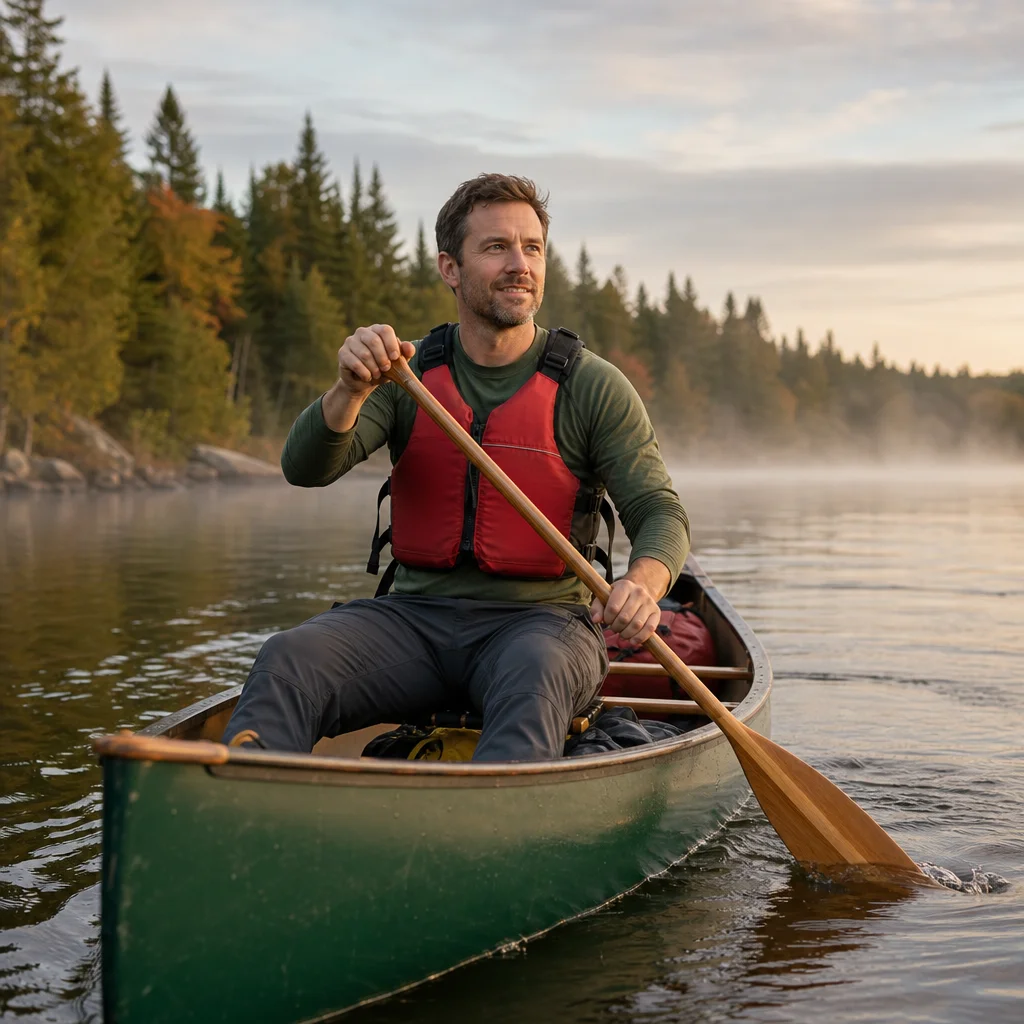
Reservoir crossings can look deceptively simple on a map. The distance may be short, the water may appear calm near the launch, and the opposite shore may seem close enough to reach without much thought. Open water changes that calculation quickly when wind has room to build waves or motorboats turn a quiet route into a traffic problem.
I judge an exposed crossing as a decision rather than a fixed distance. The useful question isn’t only “Can I paddle this far?” It’s “What will the conditions be in the middle, what options will remain if they worsen, and how difficult will it be to turn back?”
Start with the shape of the crossing
Before considering your boat or paddling speed, study the route’s geometry. A direct line between two points may be the shortest route, but it isn’t always the safest or most manageable one.
Look for:
- The crossing’s total distance and widest open section
- Islands, points, coves, or narrowing sections that provide alternatives
- Cliffs, steep banks, private property, or dense vegetation that limit landings
- Areas where a headwind could push you away from the intended shoreline
- A route that allows you to stay within a reasonable distance of shelter
A crossing with several exit points is fundamentally different from one that leaves you committed to open water for a mile or more. Even if both routes are the same length, the first gives you more ways to respond to changing conditions.
I also distinguish between a shoreline that is visible and one that is usable. A rocky bank, a heavily vegetated edge, or a shore blocked by posted land may offer little practical refuge. Mark likely landing areas in advance rather than counting every piece of coastline as an escape option.
Understand fetch, not just the forecast wind
Fetch is the uninterrupted distance over which wind can blow across the water. Longer fetch generally gives waves more opportunity to grow, while a short fetch may produce smaller, less developed waves even in similar wind.
Reservoirs can be especially tricky because their long, narrow shape may line up with the prevailing wind. A crossing that runs directly across the widest part of the reservoir can receive more developed waves than a route near a protected arm. Wind direction can also change how exposed each leg becomes.
Consider three questions:
- What direction is the wind expected to come from?
- How much open water lies upwind of the crossing?
- Will the wind angle change as I move across the reservoir?
A crosswind may be more difficult than a headwind for some canoeists because it can repeatedly tip the boat toward the windward side. A following wind may feel helpful but can make steering and wave control harder, particularly when waves begin to overtake the canoe at an angle.
The forecast’s average wind speed doesn’t tell the whole story. Gusts, wind shifts, local acceleration around points, and waves already present on the reservoir matter too. Watch the water from shore if possible. Wind streaks, whitecaps, waves breaking against exposed banks, and visible spray are useful evidence that conditions have moved beyond what the forecast number alone suggests.
Check the crossing window: Before launching, compare the latest wind and thunderstorm forecast with the reservoir’s orientation and your planned route. Confirm local advisories, navigation rules, and access restrictions, since conditions and regulations vary by reservoir and can change during the season.
Treat the middle of the crossing as the key test
Many paddlers evaluate a crossing by its starting conditions. That’s a mistake because the most important point is usually the middle, where the shoreline is farthest away and a retreat takes the most time.
Ask what the water will be like when you are halfway across, not just what it looks like from the launch. A modest breeze can become tiring when you must maintain a steady angle for several minutes. Small waves can also become more consequential when they arrive from the side and the canoe is loaded with camping equipment or a high volume of loose gear.
Your margin is reduced if:
- You’re already working hard to hold course near shore
- The boat is difficult to turn or brace in the current conditions
- Your partner has limited experience in wind and waves
- The water is cold enough that a capsize would quickly become a serious emergency
- You’re paddling late in the day with limited time to recover or reroute
A crossing isn't a good place to discover that your comfortable flat-water pace doesn’t translate to exposed water. If the route requires constant corrective strokes before you leave the sheltered shoreline, treat that as information and reconsider.
Evaluate boat traffic as a separate hazard
Motorboat traffic creates more than a wave problem. It can obscure your view, force rapid course changes, and produce wakes that arrive after the boat itself has passed. On busy reservoirs, the safest route may not be the shortest route.
Study the reservoir’s marked channels, launch areas, fishing zones, swimming areas, and likely high-speed routes. Keep clear of places where boats are accelerating, turning, or converging. A canoe can be difficult for a fast-moving operator to see, especially when you’re below the horizon of the water or approaching a bright, reflective background.
If you must cross a traffic area, make the crossing direct and predictable. Avoid drifting diagonally through a marked route or stopping in the middle to adjust equipment. Secure loose items before leaving shore so you won’t need to rummage while exposed.
Visibility matters. Bright clothing, a properly displayed light when required, and a whistle or other signaling device can improve your ability to communicate, but none substitutes for avoiding high-traffic water when you have a better alternative.
Build a real turnaround point
“Turn around if it gets bad” sounds sensible until you’re tired, wet, or already committed to a difficult angle. Set a turnaround point before you leave shore.
That point can be based on location, time, or conditions. For example, you might decide to turn back if:
- Waves become large enough that you can’t comfortably keep the canoe aligned
- Gusts repeatedly knock you off course
- You need frequent corrective strokes just to maintain progress
- A partner becomes anxious, fatigued, or unable to follow the agreed plan
- Boat traffic increases beyond what you can manage safely
- Thunderstorms, rapidly darkening skies, or a changing wind direction appear
The rule should be easy to recognize while paddling. “If it feels unsafe” may be too vague under pressure; “If we can’t maintain a stable course without bracing hard” is more useful.
Turn around while you still have energy and room to maneuver. A retreat that is easy near the start can become exhausting after you’ve spent most of your reserves crossing toward the far shore.
Choose the safest crossing angle
The shortest line isn’t automatically the best line, but a longer route can also increase exposure. Compare the direct route with a staged route that uses an island, point, or protected bay.
A staged crossing may reduce the longest uninterrupted leg and provide a chance to reassess. It can also put you closer to boat traffic, shallow rocks, or a shoreline with no landing access, so don’t assume that breaking a crossing into sections makes it safe by itself.
When wind is present, a modestly angled route may help you avoid taking waves directly on the side. However, deliberately zigzagging across open water can prolong exposure and make your intentions less clear to boat operators. Pick a route that balances wave angle, distance, shelter, and visibility.
Prepare the canoe and paddlers
Good judgment begins with a boat that remains manageable when conditions change. Keep heavy gear low and centered, secure every item, and leave enough room for paddlers to move or brace without catching on straps. Avoid overloading the canoe or allowing water to collect inside it.
Everyone should wear a properly fitted personal flotation device throughout the crossing. Carry communication and signaling equipment appropriate to the remoteness of the reservoir, and protect it from water. A bailer or pump should be immediately reachable rather than buried under dry bags.
Agree on simple roles before launching. Decide who watches traffic, who calls for a turn, where you’ll regroup, and what you’ll do if someone capsizes. If the canoe is tandem, clear communication is more valuable than trying to make every stroke powerful.
Cold water deserves particular attention. Air temperature can make a day feel comfortable while the reservoir remains dangerously cold. A capsize far from shore isn't merely an inconvenience in those conditions. Use equipment, clothing, and rescue planning appropriate to the water temperature and the distance from help.
A practical go-or-no-go checklist
Before crossing, I want clear answers to these questions:
- Is the wind direction favorable for the route, and how much fetch is involved?
- Are the current waves within the canoe and paddlers’ demonstrated ability?
- Can I identify usable landing points or protected alternatives?
- What is my specific turnaround trigger?
- How busy is the water, and can I avoid the main traffic areas?
- Is there enough daylight and energy for a return or reroute?
- Are the weather, water temperature, local rules, and access conditions suitable today?
If several answers are uncertain, the uncertainty itself is a reason to shorten the route, wait, or stay in protected water. A reservoir will still be there after the wind settles.
Practical next steps
On your next trip, scout the crossing from shore before committing. Mark the widest exposed section, identify two or three genuine landing options, and watch how wind affects the water around points and open bays. Start with a shorter crossing in mild conditions, then compare what you observed with the forecast.
The goal isn’t to eliminate every wave or guarantee a calm route. It’s to preserve choices. When fetch, traffic, shoreline access, and turnaround limits all fit within your abilities, an exposed crossing becomes a manageable plan instead of a hopeful shortcut.