Canoe Trip Communication When Partners Have Different Risk Tolerances
When one paddler wants to continue and another is watching the wind nervously, I use a simple conversation framework to agree on limits, turnarounds, portages, and a respectful plan for ending the day early.
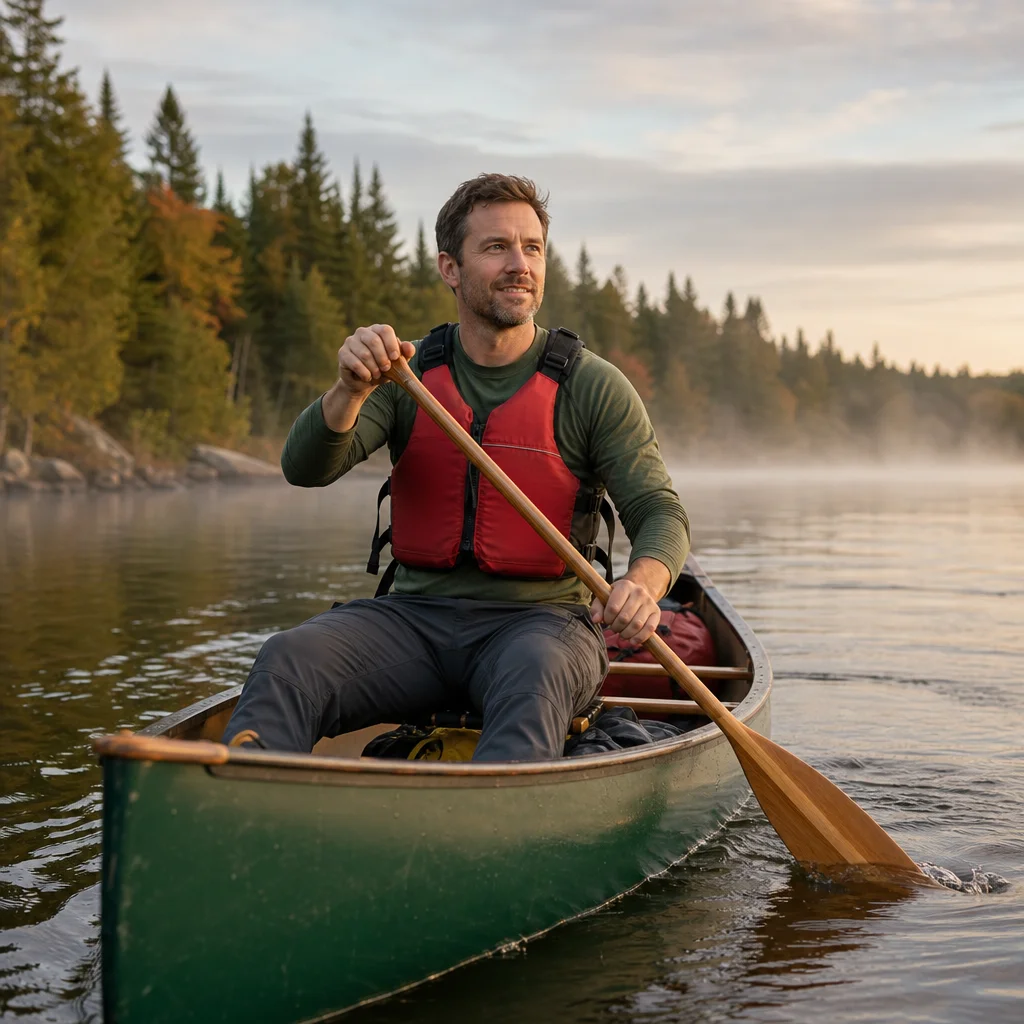
Different risk tolerances can turn an ordinary canoe decision into a relationship problem. One paddler sees manageable chop; the other sees a situation becoming harder to control. Neither person needs to be reckless or timid for the disagreement to matter.
The solution is to discuss likely decisions before launching, while both partners are calm and still have options. The goal isn’t to make everyone equally adventurous. It’s to create rules that protect the less comfortable paddler without making the more confident one guess what “too much” means.
Start with the decisions most likely to cause conflict
A useful conversation is specific. “We’ll be careful” sounds reassuring but doesn’t tell either paddler what will happen when conditions change.
Before the trip, discuss:
- How much wind or wave action feels acceptable
- Whether you’ll cross open water or stay near shore
- When you’ll turn around
- Which portages are acceptable and which aren't
- What happens if one person wants to stop
- How you’ll respond to fatigue, cold, illness, or a damaged canoe
- Whether the group has enough time to change plans without rushing
You don’t need to predict every detail. You do need a shared response to the common turning points.
Treat discomfort as information, not a vote to win
Risk tolerance is partly about skill and experience, but it can also reflect fatigue, unfamiliar surroundings, cold water, weather uncertainty, or a previous bad incident. A paddler who says, “I’m not comfortable crossing this,” may be identifying a real change in the situation even if the other person feels capable.
At the same time, discomfort doesn’t automatically prove that the route is unsafe. It may mean the plan needs adjusting, a short rest, a different line, or a return to shore for a better look.
A productive response is to ask:
- “What specifically feels wrong right now?”
- “Is it the waves, the distance, the wind, or how tired you are?”
- “Would staying close to shore change your view?”
- “What would make this feel manageable?”
These questions turn a vague disagreement into a decision the pair can evaluate.
Avoid debating whether someone is “overreacting.” That usually makes the person less willing to speak up later, when early communication matters even more.
Set a conservative default for tandem paddling
In a tandem canoe, both paddlers are part of the control system. If one person is tense, hesitant, or no longer willing to continue, coordination may deteriorate even if the canoe is technically within its capabilities.
For that reason, a sensible default is: either paddler can call for a pause, a return to shore, or a change of plan without needing to prove a case first.
This isn’t a rule that every concern ends the trip immediately. It’s a rule that stops the conversation from happening in the middle of a difficult crossing. Once safely ashore, you can assess the issue and decide whether to continue under different conditions.
The more confident paddler should be especially careful not to use physical strength or steering authority to override a partner. The less confident paddler should also explain concerns early rather than waiting until fear makes communication abrupt.
Agree on wind and wave limits in plain language
Wind forecasts are useful, but a forecast number doesn’t translate perfectly to every lake, river, canoe, load, or paddler. A sheltered shoreline may remain manageable while an exposed crossing develops short, uncomfortable waves. Gusts can matter more than the average wind.
Instead of relying only on a number, combine forecast information with observable limits. For example:
- We won’t make an exposed crossing if the wind is forecast to rise beyond our agreed range.
- We’ll stay on the protected side of the lake if waves begin splashing over the bow or making conversation difficult.
- We’ll turn back if either paddler can’t maintain a steady stroke without bracing or feels unable to keep the canoe balanced.
- We’ll stop for a reassessment when gusts, waves, or visibility change noticeably.
The exact limits should match the canoe, load, route, skills, and local conditions. A rule that works on a small sheltered pond may be unsuitable on a broad lake with few landing options.
Check the day’s limits: Before launching, compare the current forecast, water conditions, route exposure, and local advisories with the limits you’ve agreed on. Conditions and access rules can change, so confirm them through a current, reliable local source.
Make the turnaround rule automatic
A turnaround rule is easier to follow when it’s tied to a recognizable point rather than a mood. You might turn around when:
- The group reaches a certain time of day
- The wind is expected to increase during the return window
- You’ve used half the available daylight or energy
- The route’s next section is more exposed than the section you’ve completed
- A paddler’s comfort drops below the agreed threshold
- The return trip would become difficult if conditions worsened
Build in margin. “We’ll turn around if we’re not at the far point by noon” is generally more useful than “We’ll turn around if we’re running late.”
For a small group, decide whether the turnaround applies to everyone. Splitting up can create additional communication and supervision problems, especially if not every paddler has the same equipment, experience, or ability to navigate independently.
Discuss portages as trade-offs, not punishments
Portages often expose different priorities. One paddler may prefer carrying the canoe over a rough trail to avoid open water. Another may see the portage as exhausting, slippery, or unrealistic with the group’s equipment.
Before the trip, identify:
- The length and difficulty you’re willing to accept
- Whether the canoe can be carried safely by the available people
- How many trips with packs or gear are realistic
- Whether a portage has steep, muddy, narrow, or poorly maintained sections
- What alternative route exists if the carry is worse than expected
Don’t describe a portage as the “easy option” unless you’ve considered the actual carry. A short, steep trail can demand more attention than a longer, level one. If the group reaches a portage and one person objects, secure the canoe, take a break, and inspect the route together rather than arguing beside moving water.
A pre-trip agreement might be: “We’ll inspect any unexpected portage. If it requires a carry beyond our agreed effort or footing tolerance, we’ll return or choose the safer alternative.”
Use a three-level decision system
A simple set of shared categories can prevent every decision from becoming a fresh negotiation.
Green: continue as planned
Conditions are within the agreed range. Both paddlers are alert, warm enough, and comfortable with the route. Continue, while still watching for change.
Yellow: pause and modify
Something has changed, but the situation remains controlled. Examples include rising wind, increasing fatigue, a minor equipment issue, or a paddler becoming uneasy. Move to shore if appropriate, communicate clearly, and choose a less exposed route, shorter objective, longer rest, or earlier return.
Red: stop the objective and prioritize safety
A paddler feels unable to continue safely, the canoe is becoming difficult to control, someone is cold or impaired, visibility is deteriorating, or the group has lost its margin for error. Land or reach a secure location as soon as practical, then deal with the next problem one step at a time.
The key is to agree that “yellow” isn't failure. It’s the stage where changing the plan is still relatively easy.
Give the less comfortable paddler a real role
A partner who feels ignored may become quiet, distracted, or reluctant to mention concerns. Shared responsibility helps. Let both paddlers participate in checking the forecast, reading the shoreline, choosing landing spots, and tracking time.
The more experienced paddler can explain what they’re seeing without turning the trip into a lesson during a stressful moment. Instead of saying, “This is nothing,” try, “The waves are still small, but we’re exposed for another twenty minutes. We can stay close to shore or turn back now.”
Likewise, the less experienced paddler can describe observations rather than issuing accusations: “I’m having trouble keeping my balance when the gusts hit,” gives the partner something useful to respond to.
What to say when someone wants to stop
Use a short sequence:
- Stop paddling or move toward a safe landing area.
- Acknowledge the concern without sarcasm or argument.
- Ask what the person needs: a pause, shore, a route change, or an end to the trip.
- Check the actual conditions and remaining options.
- Choose the most conservative workable plan.
A useful phrase is: “Let’s get somewhere stable, then decide.” It keeps the discussion out of the most demanding part of the route.
If the concern is immediate—capsize risk, severe cold, injury, rapidly worsening weather, or loss of control—skip the debate and focus on landing or stabilizing the canoe according to your training and the situation.
Keep the agreement short enough to remember
Write down a few rules or say them aloud before launching:
- Either paddler can call a pause.
- We turn around at the agreed time or condition.
- We don’t make exposed crossings when either person is uncomfortable with the margin.
- We inspect unexpected portages before committing.
- We change plans early rather than waiting for conditions to force the decision.
- We treat an early return as a successful risk decision, not a ruined outing.
After the trip, briefly discuss what worked. Did the wind limit make sense? Was the turnaround too late? Did the portage description match reality? Adjust the plan for next time without assigning blame.
A good communication plan doesn’t eliminate differences in risk tolerance. It gives those differences a safe place in the decision. When both paddlers know the limits, the signals, and the exit options, they can spend less energy defending their judgment and more energy keeping the canoe under control.