Choosing a Canoe Route for a Mixed-Ability Group
A short route may be safer than a scenic challenge when paddlers differ in stamina and confidence. I’ll show you how to compare distance, wind, landing options, portages, and rescue demands before choosing a route your whole group can manage.
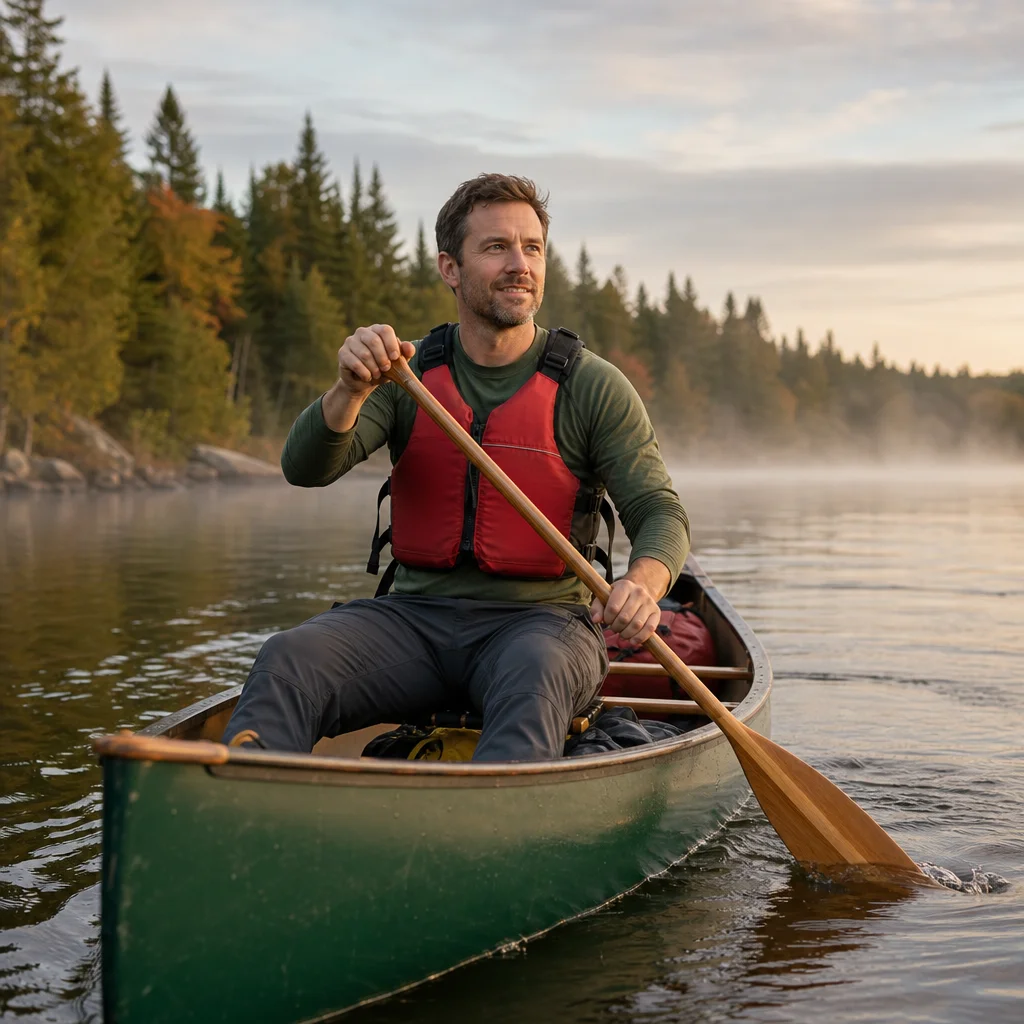
The most ambitious paddlers often choose the route, while the least experienced person quietly determines how the day will actually go. That mismatch can turn an enjoyable outing into a long, stressful paddle—or create a situation where a tired person has little margin for error.
For a mixed-ability group, I choose a route around the least experienced paddler’s stamina, confidence, and rescue needs. Stronger paddlers can always move more slowly, carry extra gear, or treat a familiar waterway as a relaxed outing. A route that exceeds the weakest paddler’s limits gives the group fewer good options when conditions change.
Start with the group, not the map
Before comparing lakes, rivers, or distances, get an honest picture of who is coming. “Beginner” can mean someone who has never held a paddle, or someone who paddles confidently but has little experience with wind, current, cold water, or loaded boats.
Ask about:
- Previous canoeing and swimming experience
- Comfort sitting or kneeling in a canoe for several hours
- Fitness, mobility, and stamina
- Comfort with waves, boat movement, and unexpected splashes
- Any medical, sensory, or balance concerns the trip leader should plan around
- Whether the person can follow instructions during a capsize or other emergency
- Familiarity with personal flotation device use
You don’t need to turn the conversation into an examination. The aim is to identify constraints that affect the route. Someone who is nervous in open water may be perfectly comfortable on a sheltered, narrow lake. Someone with good fitness may still struggle with a long portage or repeated launches.
The group should also agree on what “a good day” means. A family outing focused on swimming and lunch needs a different route from a training paddle where experienced adults want distance. If the goals conflict, safety and participation should take priority over the strongest paddlers’ mileage target.
Judge route difficulty by more than distance
Mileage is easy to see on a map, but it’s only one part of the workload. A short route can be demanding if it crosses exposed water, has a difficult landing, or requires several steep carries. A longer route may be manageable if it stays sheltered and offers frequent places to stop.
Evaluate these factors together:
Exposure to wind and waves
Broad lakes and large reservoirs can become uncomfortable when wind builds. The distance across open water matters, but so does the direction of travel. A route that begins with a favorable breeze may become much harder on the return, when the group is tired.
For a mixed-ability group, look for shorelines, islands, coves, and alternate landing points that allow you to shorten the crossing. Avoid treating a large body of water like a narrow lake just because the forecast looks calm at the launch.
Current and moving water
Current adds a task that flatwater paddlers may not yet understand. Even a modest flow can make ferrying, turning, landing, and keeping the group together more complicated. River routes also require attention to strainers, undercut banks, low-head dams, rapids, and areas where a swimmer could be carried away from shore.
If anyone lacks moving-water experience, choose a flatwater route or a section with appropriate instruction and straightforward alternatives. A route shouldn't depend on a beginner learning river control while the group is already committed.
Portages and landings
Check the number, length, surface, slope, and likely condition of every portage. A short carry with uneven rocks or muddy steps may be harder than a longer, level trail. Also consider whether the least experienced paddler can safely get out of the canoe at each landing.
A route with one optional, easy landing is very different from one that requires repeated transfers at steep or slippery banks. Count the work involved in moving boats and shared gear, not just the walking distance.
Navigation and communication
A route with many branches, islands, or confusing shorelines demands more attention than a simple out-and-back. Poor visibility, fatigue, and changing weather can make basic navigation less obvious than it looked at home.
Choose routes where the group can regroup often and where a paddler who falls behind remains visible or easy to locate. If cell service is unreliable, plan how the group will communicate without relying on a phone call.
Use the least experienced paddler as the planning baseline
The least experienced person shouldn’t be treated as a problem to manage. They are the clearest test of whether the route provides enough margin for the whole group.
Ask practical questions:
- Can they paddle for the expected time without becoming too tired to follow instructions?
- Can they get back into the canoe with assistance if they fall out?
- Can they remain comfortable if the group must wait on shore?
- Do they know how to stay with the canoe after a capsize?
- Would they recognize when conditions are becoming unsafe?
- Can the group reach a safe landing before their energy runs out?
If the answers are uncertain, reduce the route’s commitment. Choose a shorter loop, an out-and-back, or a sheltered area with several exit points. A route that can be shortened without a difficult decision is especially valuable for families and mixed groups.
Build in a turnaround point and bailout options
A route plan should include more than a launch and destination. Mark the point where the group will turn around, along with places where you can land, rest, reorganize, or end the trip early.
A useful turnaround rule is based on the group’s condition rather than a fixed distance. For example, you might turn around when the least experienced paddler reaches a planned rest point, when the wind increases, or when the group has used a set portion of its available energy and daylight. Decide this before launching so nobody has to argue for a change when tired.
Bailout options might include:
- A nearby landing reachable without crossing open water
- A road, campground, or trail where help can be arranged
- A shorter loop that reconnects with the launch
- A safe place for one paddler to wait while the rest reposition boats and gear
- A route segment that can be skipped if a portage or crossing becomes unsuitable
Don’t count an option as a bailout merely because it appears on the map. Confirm that it has a usable shoreline, enough room to bring boats in, and a realistic way to get people and equipment out.
Match the route to the forecast and season
Weather and water conditions can change the practical difficulty of a route. Wind direction, temperature, rain, visibility, and the likelihood of storms all matter. Cold water deserves particular attention because a capsize can become a serious emergency even on a warm day.
For a mixed-ability group, favor routes with shelter and close access to shore when conditions are uncertain. Don’t use a favorable forecast as permission to ignore the route’s exposed sections. Forecasts are estimates, and local wind can behave differently around cliffs, open fields, and large bodies of water.
Seasonal conditions also affect portages and landings. High water may alter current and hide hazards; low water can expose rocks and make launches awkward. In colder months, shorter routes with simple exits provide more safety margin than ambitious crossings.
Confirm the day’s local conditions: Before you leave, check current weather, water levels, access notices, hazards, seasonal closures, and any local boating requirements for the specific launch and route. Conditions and regulations vary across North America, so use the relevant park, land manager, or emergency-services information rather than relying on an old trip report.
Give the strongest paddlers useful jobs
Experienced paddlers can make a mixed group safer without turning the outing into a race. Assign roles before launch so everyone knows who is responsible for what.
A strong paddler might:
- Lead the group while keeping the pace comfortable
- Stay at the back and make sure no canoe is left behind
- Carry a map, communication device, first-aid supplies, or repair kit
- Help with difficult landings and boat handling
- Demonstrate efficient strokes and stable body movement
- Watch for changing wind, current, or fatigue
Avoid placing all experienced paddlers in front while beginners struggle at the rear. A front-and-back arrangement usually works better, with regular regrouping at visible landmarks. The leader should be able to slow down without embarrassment, and the rear paddler should be willing to report when the group needs a break.
Choose boats and loads that increase stability
The route and the equipment should support each other. A stable tandem canoe with enough capacity for people and gear may be a better choice than a narrow, fast boat for a group still building confidence. Keep heavier items low and centered, secure loose equipment, and leave room for the group’s safety gear.
Pairing matters, too. A beginner may benefit from sitting with a calm, competent paddler who can communicate clearly. Putting two inexperienced paddlers together on a windy route can create more work for everyone, even if both are enthusiastic.
Avoid overloading a canoe or filling every available space. A heavily loaded boat sits lower, handles differently, and may be harder to recover after a capsize. Follow the canoe manufacturer’s capacity guidance and account for people, equipment, and water carried inside the boat.
Set simple group rules before launching
A short briefing prevents confusion later. Explain how the group will stay together, where to stop, and what to do if someone capsizes or loses contact.
Cover at least these points:
- Everyone wears a properly fitted personal flotation device while on the water.
- No canoe passes the leader or falls behind the rear paddler without agreement.
- The group stops at planned landmarks and whenever someone signals a problem.
- A tired, cold, frightened, or uncomfortable paddler can ask to turn around without criticism.
- In a capsize, everyone stays with the canoe unless shore is immediately reachable and the leader gives clear direction.
- A paddler who loses sight of the group stops moving and follows the prearranged communication plan.
The exact emergency response depends on the water, equipment, and training. A group without rescue practice should avoid routes where a capsize would require a complex open-water recovery.
Compare route options with a simple scorecard
When two routes look appealing, score each one for the factors that matter most to your group. Use a simple scale such as low, moderate, or high for:
- Distance and expected paddling time
- Open-water exposure
- Current or technical hazards
- Portage difficulty
- Number and quality of bailouts
- Navigation complexity
- Access to help or communication
- Cold-water or weather consequences
- Fatigue likely at the end of the route
The best route usually isn’t the one with the lowest score in every category. It’s the one whose difficult features the group can handle with room to spare. If a route has high exposure, difficult landings, and no practical bailout, it may be unsuitable even when its mileage is modest.
Practical next steps
Start with the least experienced paddler’s realistic limits, then select a route that keeps the group close to shore, offers easy exits, and leaves energy for the return. Check the specific launch and conditions on the day, assign experienced paddlers clear support roles, and agree on a turnaround rule before anyone gets in a canoe.
If you’re still uncertain, make the first outing shorter than the group’s maximum capability. A relaxed trip that ends with everyone wanting another paddle is a better test of route choice than a difficult day that proves the map was technically accurate.